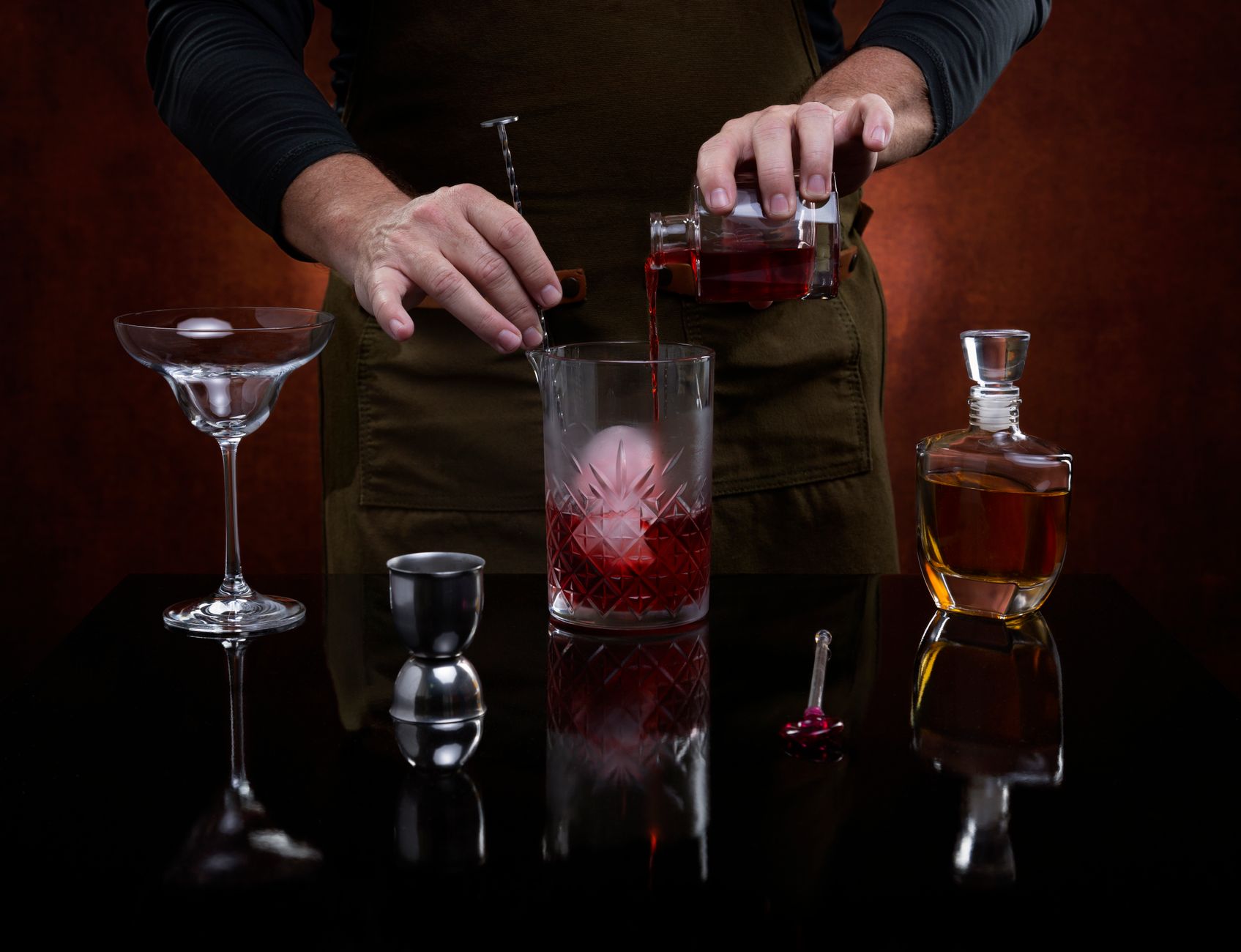
Why the Manhattan is always stirred, how long to stir it, what dilution does to the drink, and why the sweet vermouth deserves as much care as the rye.
By the end of this article you'll be able to stir a Manhattan that comes out cold, clear and balanced, shift after shift. The short version: stir it in a mixing glass with ice for 30–40 seconds, strain it into a chilled coupe, and give the sweet vermouth the same respect you give the rye.
That's the whole method. The rest explains why each part matters, so you can fix the drink when a guest sends it back.
Why the Manhattan is stirred, not shaken
The rule behind the bar is easy to remember:
- Shake drinks with citrus, juice, dairy or egg.
- Stir drinks made only of spirits, liqueurs and bitters.
A Manhattan is rye whiskey, sweet vermouth and Angostura bitters. Nothing in it needs the hard mixing that citrus or egg does.
Shaking also changes how the drink looks and feels. It beats air and ice chips into the liquid, which clouds it. Our recipe notes are clear: always stir, never shake, to keep the drink crystal clear. A stirred Manhattan should look like polished amber and feel silky.
Dilution is an ingredient, not an accident
Dilution is the water that melts off the ice while you chill a drink. Stirring or shaking adds about 1 oz (30 ml) of water, according to our Cocktail Basics guide, and that water is part of the recipe.
Run the numbers. A Manhattan is 3 oz (90 ml) of rye and vermouth plus bitters, so about 4 oz (120 ml) ends up in the glass. That water does real work:
- It softens the alcohol heat of the rye.
- It lets the whiskey and vermouth flavors come forward.
- It brings the drink down to a cold drinking temperature.
Miss in either direction and the guest notices. Too little dilution leaves the drink hot and syrupy. Too much leaves it thin and flat.
That's why the spec calls for 30–40 seconds of stirring. A stir moves the ice far more gently than a shake, so it needs more time to chill and dilute the drink.
How to stir a Manhattan, step by step
A mixing glass is a heavy, wide glass built for stirred drinks. A barspoon is the long, thin spoon with a twisted handle. A jigger is the double-sided measuring cup.
- Chill the coupe first. Fill it with ice and water, or keep it in the freezer, while you build the drink.
- Measure into the mixing glass. Jigger the vermouth, then the rye, then add the bitters. From the Classroom, below, explains the order.
- Add plenty of ice. Fill well above the liquid line with cold, dry ice. Wet, melting ice dilutes faster than you can control.
- Set your grip. Hold the barspoon between your fingers like a pencil, with the back of the bowl against the inside of the glass.
- Stir smoothly for 30–40 seconds. Run the spoon around the edge so the ice spins as one mass. It should be nearly silent. Churning up and down splashes the drink and chips the ice.
- Check it. Taste a drop with a clean straw. It should be cold and smooth, with no burn.
- Strain. If you iced the coupe, dump it, then strain the drink in. Don't leave the drink sitting on the ice, because it keeps diluting.
- Garnish with a brandied cherry.
Why the vermouth matters as much as the whiskey
It's easy to fuss over the rye and grab whatever vermouth is open. For this drink, that's backwards.
The vermouth is a full third of what you pour: 1 oz against 2 oz of rye. It carries most of the drink's sweetness and much of its aroma, so a tired bottle makes even a good whiskey taste dull. Our recipe notes call for a quality sweet vermouth.
Know the two styles, and the Variations guests order by name:
| The guest orders… | Vermouth used | What that vermouth brings |
|---|---|---|
| Manhattan | Sweet | Amber color, sweet flavor |
| Dry Manhattan (Variation) | Dry instead of sweet | Almost white, tart |
| Perfect Manhattan (Variation) | Both sweet and dry | A mix of the two |
Vermouth is wine-based, so an open bottle fades over time. Store it like wine, not like whiskey.
Shift Note: Smell the sweet vermouth before your first Manhattan of the night. If it smells flat or sour instead of bright, open a fresh bottle, and keep it capped in the cooler rather than on the back bar.
From the Classroom
In Lesson 4, Martinis & Manhattans, the rule is short: "Vermouth is always poured in first." The lesson explains that vermouth's strong taste and aroma are there to support the cocktail, not overpower it, and that pouring it first keeps the drink mixed properly.
That order has a practical bonus on a busy rail. If you over-pour the vermouth, you catch it before any rye is in the mixing glass and can correct it without wasting whiskey.
The same lesson covers garnish (a cherry with sweet vermouth, a lemon twist for a perfect Manhattan) and two service habits: ask whether the guest wants it straight up or on the rocks, and set down a glass of water with the drink, since these cocktails are strong in taste and alcohol.
The water is good service, and it gives the guest an easy way to pace themselves.
Common Manhattan mistakes
- Shaking it. You get a cloudy, frothy drink. Stir every time.
- Skipping the glass chill. A warm coupe warms the drink you just spent 30–40 seconds chilling.
- Cutting the stir short. The drink comes out warm and boozy. Give it the full time.
- Letting it sit on the ice. Strain as soon as you finish stirring, or dilution keeps going.
- Using small, wet ice. It melts too fast and waters the drink down.
- Pouring stale vermouth. The drink tastes flat no matter how good the rye is.
- Mishearing "dry." In a Martini it means less vermouth. In a Manhattan it means dry vermouth instead of sweet.
The spec
This matches our Manhattan recipe. Once it's in your hands, try the Old Fashioned, a related whiskey classic.
Pour Spec — Manhattan
- 2 oz (60 ml) rye whiskey
- 1 oz (30 ml) sweet vermouth
- 2 dashes Angostura bitters
Glass: coupe (or martini glass), chilled · Ice: none in the glass; stir over ice in a mixing glass · Garnish: brandied cherry
Method: stir in a mixing glass with ice for 30–40 seconds until well chilled, then strain into the chilled glass
Keep building your fundamentals
Stirring is one of five core techniques, alongside shaking, muddling, straining and layering. Our 37-page guide walks through all five, plus 10 classic cocktails every bartender should know, the Manhattan included.
Get the Free Cocktail Basics Guide
We train students in person, online and one-on-one nationwide — call 1-888-901-TIPS and we'll find the option that fits you.
Drafted with AI assistance from our course material.
Drafted with AI assistance from our course material .
