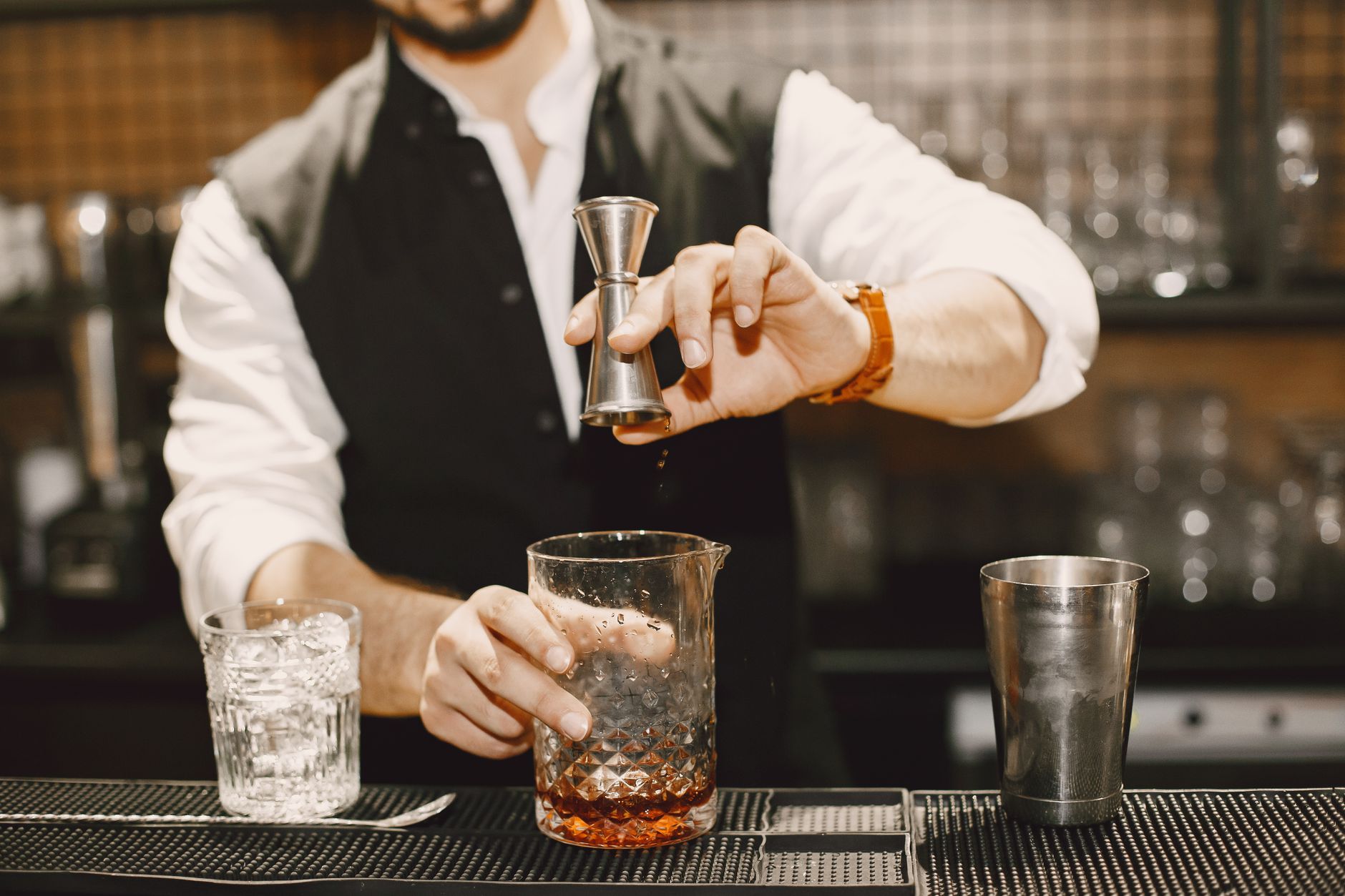
The shaken vs stirred rule in one line, the exceptions that matter, how to stir in a mixing glass, and how to explain your call to a guest.
By the end of this article you'll know when to shake a cocktail, when to stir it, and how to explain the call to a guest in one sentence. Here's the rule: shake any drink that contains citrus, juice, dairy or egg white; stir any drink made only of spirits, liqueurs and bitters.
That's the rule our free Cocktail Basics guide teaches, and it should be your default on every order. Below you'll find the technique behind each method, the exceptions, and the mistakes that give a drink away.
Why the method matters
Shaking and stirring do the same three jobs in different ways: they chill the drink, dilute it and set its texture.
- Dilution is the water that melts off the ice into the drink. Our Cocktail Basics guide puts it at about 1 oz (30 ml) per drink from shaking or stirring. That water is part of the recipe, not a flaw.
- Shaking throws the liquid against the ice. It chills fast, pulls in air and blends citrus, dairy or egg into a bright, lightly frothy drink. It also turns the drink cloudy.
- Stirring chills and dilutes with far less air. A spirit-only drink stays clear and silky, which is why our Manhattan recipe says to always stir it, never shake it.
Here's how four classics from our recipe library break down:
| Drink | Method | Time | Served |
|---|---|---|---|
| Manhattan | Stir in a mixing glass | 30–40 sec | Strained up into a chilled coupe |
| Old Fashioned | Build and stir in the rocks glass | 20–30 sec | Over a large cube or several regular cubes |
| Daiquiri | Shake in the tin | 15–20 sec | Double strained up into a chilled coupe |
| Margarita | Shake in the tin | 15–20 sec | Strained over fresh ice in a rocks glass |
The tin is the metal half of a shaker set; up means chilled and served without ice in a stemmed glass; double strained means poured through a Hawthorne strainer (the flat strainer with a coiled spring) and a fine mesh strainer together.
The stirred drinks take longer. Stirring is gentler, so it needs more time to reach the right chill and dilution.
How to stir in a mixing glass
A mixing glass is a heavy glass vessel for stirred drinks. A barspoon is the long, twisted-handle spoon you stir with. A jigger is the two-sided measuring cup you pour with.
- Chill the serving glass first. The Manhattan spec starts with a chilled coupe or martini glass.
- Load the mixing glass with ice. Fill it about three-quarters. A full load chills more evenly than a few cubes.
- Measure with a jigger. Pour each ingredient over the ice.
- Stir smoothly. Hold the spoon loosely, keep the back of the bowl against the inside wall, and turn so the ice spins as one mass. You want quiet, steady movement, not clanking.
- Time it. Stir a Manhattan for 30–40 seconds, until it's well chilled.
- Strain. Set a strainer over the mixing glass and pour into the chilled glass. The strainer keeps the ice out of the finished drink.
How to shake in the tin
Build the drink in the tin, then seal it with a second tin or a mixing glass.
- Build in the tin. Measure every ingredient with a jigger.
- Add ice and seal. Press the top piece in firmly and tap it so it holds.
- Shake hard. The Daiquiri and Margarita specs both call for a vigorous 15–20 second shake.
- Strain for the glass. A drink served up gets double strained, which catches ice shards and pulp. A drink served on the rocks gets strained onto fresh ice.
Shift Note: Before you reach for a tool, scan the order for citrus, juice, dairy or egg. If any of them is there, grab the tin. If the drink is all spirits, liqueurs and bitters, grab the mixing glass. Make the call before your hands move and you won't waste motion switching tools mid-drink.
Exceptions worth knowing
- Some stirred drinks never touch a mixing glass. The Old Fashioned is built in the rocks glass and stirred right there over ice for 20–30 seconds.
- Shaken doesn't always mean served up. The Margarita is shaken, then strained over fresh ice in a rocks glass.
- The guest's order wins. If a regular wants a shaken Manhattan, make them a shaken Manhattan. The rule is your default, not a reason to argue.
- Martinis need a house call. Gin or vodka changes how many bars handle it. Ask the guest, and see how we teach it below.
From the Classroom
Lesson 1, Bar Basics, of our online course sends stirred drinks like the Martini and Manhattan to the glass half of the shaker set. Seal the metal tin over that same glass and you have your shaker, so one set covers both methods.
In Lesson 4, Martinis & Manhattans, we teach a house convention for the Martini: "We shake 'Vodka' and stir 'Gin'." The story goes that shaking can bruise gin and turn it milky. The same lesson has students fill the glass mixing cup three-quarters with ice and pour the vermouth before the spirit when building a drink served straight up.
Whatever you make of the bruising story, a shaken drink does come out cloudier than a stirred one. A clear house default saves you guessing when a guest doesn't specify.
Mistakes that give the drink away
- Shaking a spirit-only drink out of habit. A shaken Manhattan arrives cloudy with froth on top. If the guest didn't ask for it, they'll notice.
- Cutting the stir short. A quick stir leaves the drink warm and harsh because it hasn't picked up its water. Use the full 30–40 seconds.
- Stirring a citrus drink. Without the shake, a Daiquiri tastes flat and thin instead of bright and integrated.
- A lazy shake. A slow rattle won't chill or aerate. Commit to the full 15–20 seconds with real force.
- Skipping the double strain on an up drink. Ice shards floating on a Daiquiri look sloppy and keep diluting the drink in the glass.
- Pouring the shaker ice into the glass. The Margarita spec calls for fresh ice. Broken-down shaker ice melts fast and waters the drink.
How to explain the call to a guest
When a guest asks why, keep the answer short and friendly:
- The one-liner: "Spirit-only drinks get stirred so they stay clear and smooth. Anything with citrus gets shaken so it's cold and bright."
- When they want it the other way: "Happy to. It'll come out a little cloudy with some froth on top." Then make it well.
- On a Martini order: ask "Gin or vodka?" and, if they care, "Shaken or stirred?" Asking up front beats guessing.
Pour Specs
Pour Spec — Manhattan (stirred)
- 2 oz (60 ml) rye whiskey
- 1 oz (30 ml) sweet vermouth
- 2 dashes Angostura bitters
Glass: chilled coupe (or martini glass) · Ice: stirred with ice in a mixing glass, served up · Garnish: brandied cherry Method: stir 30–40 seconds until well chilled, strain into the chilled glass
Pour Spec — Daiquiri (shaken)
- 2 oz (60 ml) white rum
- 1 oz (30 ml) fresh lime juice
- ¾ oz (22.5 ml) simple syrup
Glass: chilled coupe · Ice: shaken with ice, served up · Garnish: lime wheel Method: shake vigorously 15–20 seconds, double strain into the chilled coupe
Make them back to back and compare. The Manhattan should be clear and silky, the Daiquiri cold and lightly frothy. That contrast is the whole rule in two glasses.
Practice the five core techniques
Shaking and stirring are two of the five core techniques in our free guide, alongside muddling, straining and layering. Get the Free Cocktail Basics Guide for the tools, the techniques and 10 classic recipes to practice them on.
We train students in person, online and one-on-one nationwide — call 1-888-901-TIPS and we'll find the option that fits you.
Drafted with AI assistance from our course material.
Drafted with AI assistance from our course material .
